Companies today collect massive amounts of information from their daily operations, but raw data sitting in different systems doesn’t help anyone make better choices. A data warehouse is a central system that collects and stores large amounts of data from various sources, while business intelligence refers to the tools and methods used to analyze that stored data and turn it into useful insights for making business decisions. These two technologies work together to help you understand what’s happening in your organization and what actions you should take next.
Think of data warehousing and BI as a two step process that transforms scattered information into clear answers. Your data warehouse acts as the foundation by gathering information from sales systems, customer databases, and other sources into one organized location. Then your business intelligence tools take over by analyzing that stored data and presenting it through reports, dashboards, and visualizations that you can actually use.
Business intelligence would not be possible without the data warehouse because it provides the organized, reliable information needed to answer complex questions about your operations. When you combine data warehousing and business intelligence together, you can spot trends, identify problems, predict future outcomes, and make smarter choices based on facts rather than guesses. This partnership between storage and analysis gives your team the power to move from simply collecting data to actually using it for competitive advantage.
Key Takeaways
- Data warehouses collect and store information from multiple sources while business intelligence tools analyze that data to create useful insights
- These technologies work together to speed up decision making and help you understand patterns and trends in your business operations
- Successful implementation requires proper architecture, security measures, and clear processes for collecting and analyzing information
Core Concepts: Data Warehousing and Business Intelligence
Data warehousing creates a centralized place to store information from multiple sources, while business intelligence transforms that stored data into useful insights for making better decisions. These two concepts work together to help you turn raw information into knowledge your organization can act on.
Defining Data Warehousing
A data warehouse is a large storage system that collects and organizes information from different parts of your business. It takes data from transaction systems, business applications, and other sources and stores it in one place. Data warehousing transfers and stores data from different sources so you can access everything you need without searching through multiple systems.
The warehouse uses a specific structure to organize your data. Most data warehouses use relational databases that store processed information in tables with rows and columns. This setup makes it easy to find what you need and run reports quickly.
Your data warehouse keeps historical information over time. This means you can look at trends, compare different time periods, and see how things have changed. The system is designed to handle large amounts of data and let many people access it at the same time without slowing down.
Understanding Business Intelligence
Business intelligence refers to the tools and methods you use to analyze the data stored in your warehouse. BI deals with tools and methods that are used to analyze and access data collected from various sources. These tools help you turn numbers and facts into charts, reports, and dashboards that make sense.
Your business intelligence platform includes several components:
- Reporting tools that create regular reports on key metrics
- Dashboards that show real time information in visual formats
- Analytics software that finds patterns and trends in your data
- Query tools that let you ask specific questions about your information
BI solutions help you understand what happened in the past and what might happen in the future. You can spot problems early, find opportunities, and make choices based on facts rather than guesses.
Key Differences and Connections
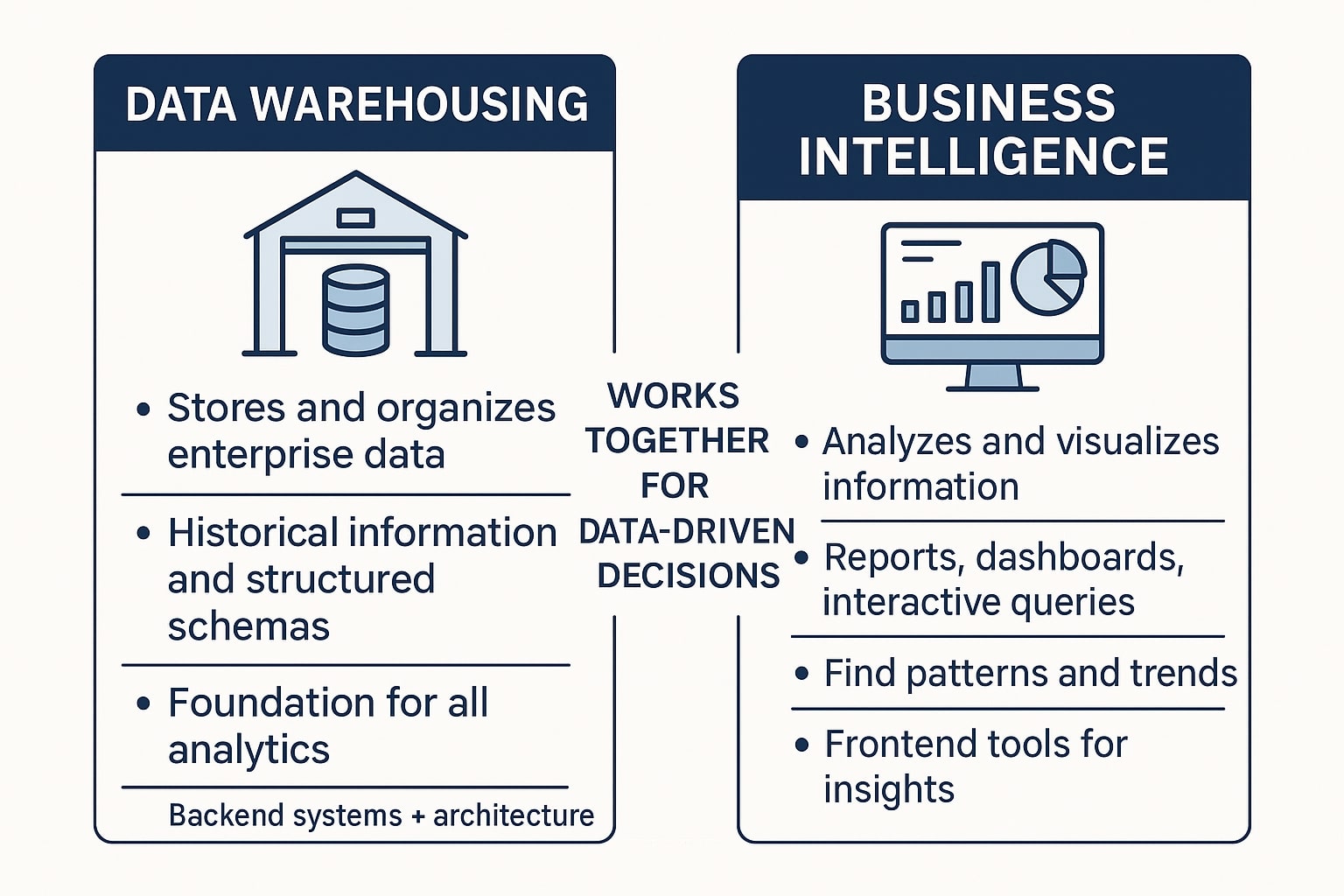
Data warehousing and business intelligence serve different purposes but depend on each other. The data warehouse is the foundation that stores your information. Business intelligence is what you build on top of that foundation to use the information.
Think of it this way: data warehousing is the storage and security phase, while business intelligence is the analysis and access phase. You need both to get value from your data.
Here’s how they compare:
| Data Warehousing | Business Intelligence |
|---|---|
| Stores and organizes data | Analyzes and presents data |
| Focuses on data structure | Focuses on insights and answers |
| Backend technology | Frontend tools and reports |
| Collects historical information | Creates actionable intelligence |
Business intelligence would not be possible without the data warehouse because BI tools need a reliable source of clean, organized information to work with. Your data warehouse ensures that everyone in your organization is looking at the same accurate information when they use business intelligence tools.
Data Warehouse Architecture and Processes
A data warehouse needs a solid structure to collect information from multiple places, transform it into usable formats, and store it efficiently. The architecture includes several key components that work together to turn raw data into valuable insights for your business.
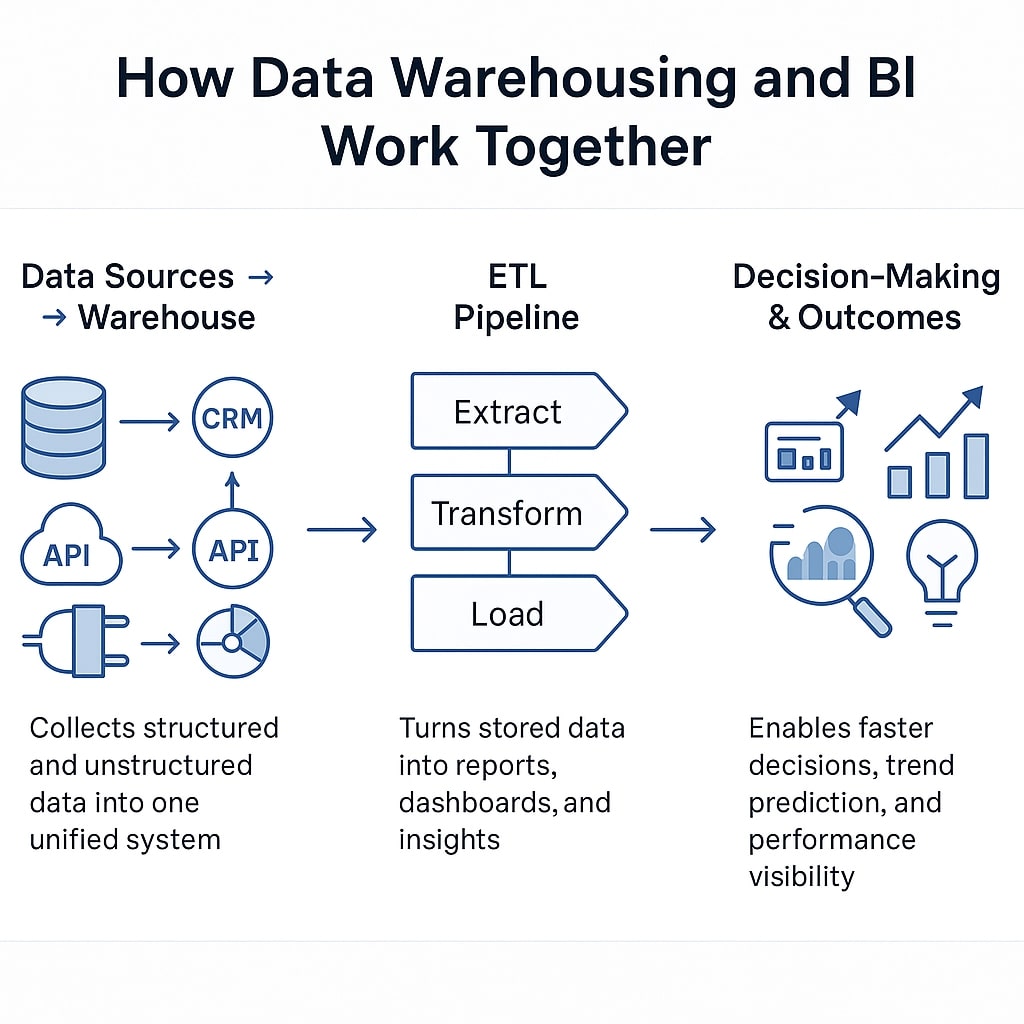
Data Sources and Integration
Your data warehouse pulls information from many different places across your business. These data sources include transactional databases from your sales systems, customer relationship management tools, and marketing platforms. You might also have unstructured data from emails, documents, and social media feeds.
Data integration brings all these separate pieces together into one unified system. This process connects to each source and extracts the information you need. Your integration layer must handle both structured data from databases and unstructured data from various applications.
Modern systems can connect to on-premise servers, cloud applications, and external APIs. The goal is to create a single location where all your business information lives together. This makes it much easier to analyze trends and make decisions based on complete information rather than isolated pieces.
ETL Process Explained
The ETL process stands for Extract, Transform, and Load. This is how your data warehouse moves and prepares information for analysis.
Extract pulls raw data from all your connected sources. This happens on a schedule you set, whether that’s every hour, daily, or in real time.
Transform cleans and shapes the data into a consistent format. This step removes duplicates, fixes errors, and applies business rules. Data quality improvements happen here, making sure everything is accurate and reliable. The transformation also converts different data types and structures into a standard format your analysts can work with.
Load moves the processed information into your data warehouse storage. You can choose to replace all data each time or just add new and changed records. This final step makes the data available for reporting and analysis tools.
Types of Data Warehouses
You have three main options for where your data warehouse lives. An on-premise data warehouse runs on servers you own and maintain in your building. This gives you complete control but requires significant IT resources.
A cloud data warehouse runs on remote servers managed by a provider. Popular options include Amazon Redshift and Snowflake, which offer flexible pricing and automatic scaling. Cloud data warehousing lets you pay only for what you use and expand capacity quickly.
Data lakes store information in its original format without structuring it first. Unlike traditional warehouses, data lakes hold both structured and unstructured data. Many organizations use both a data warehouse for structured reporting and data lakes for advanced analytics and machine learning projects.
Data Storage and Management
Your data warehouse organizes information using data modeling techniques. This creates a structure that makes queries run faster and reports generate quickly. Most warehouses use either a star schema or snowflake schema to arrange tables and relationships.
Data storage systems keep both current and historical data so you can track changes over time. This lets you compare this month’s sales to last year or spot trends across multiple quarters. The storage layer compresses information to save space and uses indexes to speed up searches.
Modern systems separate computing power from storage, letting you scale each independently. You might need more storage during busy seasons but only extra computing power during month end reporting. This flexibility helps control costs while maintaining performance.
Business Intelligence Applications and Analytics
Business intelligence applications transform raw data into meaningful insights through various analytical techniques and visualization methods. These tools enable you to monitor performance metrics, predict future outcomes, and make strategic business decisions based on concrete evidence rather than guesswork.
Data Analysis and Reporting
Data analysis forms the foundation of business intelligence by examining information to identify patterns and extract valuable insights. When you use BI tools for business reporting, you can track key performance metrics across departments and operations in real time.
Business analytics involves several techniques including data mining, which helps you discover hidden patterns in large datasets. You can generate reports that show sales trends, customer behavior, and operational efficiency. These reports give you the power to spot problems early and capitalize on opportunities quickly.
Online analytical processing (OLAP) lets you examine data from multiple angles. You can drill down into specific details or roll up information to see the big picture. This flexibility helps you answer complex business questions and conduct thorough knowledge discovery across your organization.
Regular reporting keeps stakeholders informed about business performance. You can create automated reports that deliver critical information on schedules that work for your team, ensuring everyone has access to the data they need for analytical purposes.
Data Visualization Techniques
Data visualization tools turn numbers and statistics into visual formats that are easier to understand and share. You can use charts, diagrams, and infographics to communicate complex information clearly to both technical and non-technical audiences.
Tableau and other visualization platforms help you create interactive dashboards that display key metrics at a glance. Bar charts work well for comparing values, while line graphs show trends over time. Pie charts illustrate proportions, and heat maps reveal patterns in large datasets.
Data storytelling combines visuals with narrative to make your findings more compelling. When you craft data stories, you guide viewers through insights in a logical sequence that builds understanding. This approach makes it easier for decision makers to grasp what the data means for the business.
Effective visualizations highlight the most important information without cluttering the display. You should choose colors, labels, and formats that enhance clarity rather than distract from your message.
Predictive and Advanced Analytics
Predictive analytics uses historical data to forecast future outcomes and market trends. You can apply statistical models and machine learning algorithms to predict customer behavior, sales performance, and potential risks before they materialize.
Advanced analytics techniques go beyond basic reporting to uncover deeper insights. You might use regression analysis to understand relationships between variables or clustering to group similar customers together. These methods help you identify opportunities that simple reporting would miss.
Business analytics at this level supports strategic planning by showing you what might happen under different scenarios. You can test assumptions and model various business strategies to see their likely outcomes. This capability reduces uncertainty when you face major decisions about resource allocation or market expansion.
The combination of predictive models and real time data gives you a competitive edge. You can respond to changing conditions faster and more accurately than competitors who rely only on historical reports.
Driving Data-Driven Decision-Making
Data driven decision making replaces gut feelings with evidence based choices. When you integrate business intelligence with data warehousing, you gain access to reliable information that supports every level of business decision making.
Strategic business decisions become more effective when backed by solid data. You can evaluate different options objectively by comparing their expected outcomes based on past performance and current trends. This approach minimizes risk and increases the likelihood of success.
BI tools make insights accessible to users throughout your organization. Managers can check dashboards to monitor their team’s progress, while executives can review high level metrics to guide company direction. This democratization of data ensures that everyone makes choices aligned with business goals.
The speed of modern business intelligence systems means you can act quickly when opportunities arise or problems emerge. You no longer need to wait days or weeks for analysis. Instead, you get answers in minutes, allowing you to stay agile in competitive markets.
Benefits, Challenges, and Best Practices
Organizations that implement data warehouses with business intelligence gain better operational efficiency, stronger data security, and improved strategic planning capabilities. These systems require careful attention to access controls, performance optimization, and alignment with business goals.
Enhancing Operational Efficiency
Data warehouses centralize information from multiple sources into one location, which eliminates the need to search through different systems. This setup saves time and reduces errors when your teams need to find specific information.
Business intelligence streamlines information resources and automates routine analytics tasks, letting your staff focus on analysis instead of data collection. Your queries run faster because data warehouses organize information specifically for reporting and analysis. You can generate reports in minutes instead of hours.
The standardized data formats in a warehouse mean your different departments work with the same numbers and definitions. This consistency prevents conflicts between teams and speeds up decision making. You also reduce data redundancies, which lowers storage costs and makes updates simpler across your organization.
Ensuring Data Security and Compliance
Your data warehouse needs strong security measures to protect sensitive business information from unauthorized access. You should implement role based access controls that limit what each user can view or modify based on their job responsibilities.
Data breaches can expose customer information, financial records, and proprietary business details. Encryption protects your data both when stored and when transferred between systems. Regular security audits help you identify vulnerabilities before attackers exploit them.
Compliance requirements like GDPR or HIPAA demand strict controls over how you handle personal information. Your data warehouse should track who accesses what data and when they access it. Data integration systems enhance data quality while supporting compliance requirements through proper governance frameworks.
You need backup and disaster recovery plans that ensure business continuity if systems fail. Test these plans regularly to verify they work when you need them most.
Maximizing Strategic Planning and Value
Strategic planning relies on accurate insights about market trends, customer behavior, and operational performance. Data warehouses enable you to answer complex questions about your data and make informed business decisions based on facts rather than guesswork.
Your executives can identify growth opportunities by analyzing historical patterns and forecasting future scenarios. The ability to drill down from high level summaries to detailed transactions gives you flexibility in your analysis. You spot problems earlier when you monitor key metrics in real time.
Combining business intelligence tools with data warehousing creates a foundation for sustainable competitive advantage. Your investment in these systems pays off through better resource allocation, targeted marketing campaigns, and optimized pricing strategies. You measure ROI by tracking improvements in revenue, cost savings, and customer satisfaction metrics that directly link to data driven initiatives.