Last Updated: March 29, 2026
Application development staff augmentation is a flexible hiring model where you temporarily add external developers or specialists to your existing team to fill skill gaps, meet project deadlines, or handle increased workloads. This approach is especially beneficial for local businesses in Nashville, TN, looking to scale their tech teams efficiently.
Application development staff augmentation is a flexible hiring model where you temporarily add external developers or specialists to your existing team to fill skill gaps, meet project deadlines, or handle increased workloads. These professionals work under your direction and integrate with your team, but you don’t have to worry about benefits, long-term contracts, or the costs that come with permanent employees. This approach gives you access to specialized talent exactly when you need it.
Whether you’re building a mobile app, upgrading your software, or launching a new digital product, staff augmentation helps you scale quickly without the hassle of traditional hiring. You keep control of your project while getting the extra hands and expertise needed to move forward. This guide will walk you through everything you need to know about making staff augmentation work for your application development needs.
Key Takeaways
- Staff augmentation allows you to temporarily add skilled developers to your team without permanent hiring commitments
- You maintain full control over augmented team members while they work directly on your projects alongside your existing staff
- This model works best when you need specific technical skills, face tight deadlines, or want to scale your team quickly without long-term overhead costs
Understanding Application Development Staff Augmentation
Staff augmentation gives you a flexible way to add skilled developers to your team without the long commitment of traditional hiring. This model lets you bring in external talent for specific projects while keeping control of your work and processes.
Definition and Core Concepts
Staff augmentation is a hiring model where you add external developers or IT professionals to your in-house team on a temporary basis. You get access to specialized skills exactly when you need them, without hiring full-time employees.
The model works through a staff augmentation provider who supplies pre-vetted talent that matches your technical requirements. These professionals work under your direction and follow your company’s processes and standards. You maintain full control over the project scope, timelines, and deliverables.
This approach fills specific skill gaps in your team. If you need a React developer for six months or a database specialist for a particular phase of development, you can add that expertise without expanding your permanent workforce.
How the Augmentation Model Works
The process starts when you identify skill gaps or resource shortages in your current team. You contact a staff augmentation provider and outline your technical needs, project timeline, and required experience level.
The provider then presents qualified candidates who match your criteria. You interview these professionals and select the ones who fit your team culture and technical requirements. Once selected, the augmented staff members integrate directly into your in-house team.
These professionals use your communication tools, attend your meetings, and follow your development workflows. You assign tasks, set priorities, and manage their daily work just like you would with any team member. The provider handles payroll, benefits, and administrative tasks while you focus on project delivery.
Staff Augmentation Versus Traditional Hiring and Outsourcing
Staff augmentation differs significantly from both traditional hiring and outsourcing. With traditional hiring, you commit to long-term employment costs including salaries, benefits, training, and office space. Staff augmentation eliminates these commitments while giving you the talent you need.
Outsourcing transfers entire projects or functions to an external company. You lose direct control over how work gets done and when tasks get completed. The outsourced team works independently with minimal day-to-day input from you.
IT staff augmentation keeps you in the driver’s seat. Your project managers assign work, set standards, and monitor progress directly. The augmented developers become temporary members of your team rather than external contractors working on their own.
| Model | Control Level | Time Commitment | Management |
|---|---|---|---|
| Staff Augmentation | High | Flexible | You manage directly |
| Traditional Hiring | High | Long-term | You manage directly |
| Outsourcing | Low | Project-based | External management |
| Managed Services | Low | Ongoing | External management |
This flexibility makes staff augmentation ideal for software development projects with changing requirements or uncertain timelines. You scale your team up or down based on current needs without the risk of overstaffing or understaffing.
Staff Augmentation vs Dedicated Development Teams vs Managed Services
When choosing how to expand your development capabilities, you need to understand the core differences in control, responsibility, and team structure. Staff augmentation gives you direct management over individual developers, dedicated teams operate as self-contained units under vendor oversight, and managed services transfer entire project ownership to an external provider.
Staff Augmentation vs Dedicated Teams
Staff augmentation brings individual developers into your existing team structure. You maintain direct control over daily tasks, workflows, and priorities. These developers work alongside your in-house staff and follow your processes.
Dedicated development teams are self-managed groups that work exclusively on your project but remain under the vendor’s management. You get a complete team including developers, designers, and QA engineers who handle the work independently.
The main difference lies in management responsibility. With staff augmentation, you need to provide direction, assign tasks, and integrate external developers into your workflows. Your project managers oversee the work. Dedicated teams manage themselves and take ownership of deliverables.
Staff augmentation works best when you need specific skills for short periods or want to fill gaps in your current team. Dedicated teams make sense for long-term projects that need full ownership and minimal hands-on management from your side. You also get better team cohesion with dedicated teams since they work together regularly.
Staff Augmentation vs Managed IT Services
Managed services involve outsourcing entire functions or projects to an external provider. The vendor takes responsibility for planning, execution, management, and results. You define requirements and expected outcomes, then step back while they handle the rest.
Staff augmentation keeps you in the driver’s seat. You control processes, make decisions, and directly supervise the augmented staff members. This is the key difference between staff augmentation and outsourcing approaches.
Control levels vary significantly between these models:
- Staff Augmentation: You manage daily work, set priorities, and control methodology
- Managed Services: Vendor manages operations, staffing, and delivery methods
Cost structures also differ. Staff augmentation typically charges hourly or daily rates for each person. Managed services often use fixed monthly fees or project-based pricing that includes all resources and management overhead.
Risk distribution changes too. With staff augmentation, you bear responsibility for project success since you manage the work. Managed services shift delivery risk to the vendor, who must meet agreed service levels and outcomes.
How to Choose the Right Model for Your Project
Your project needs should guide your decision. Consider how much control you want over daily operations and whether you have management capacity available.
Choose staff augmentation when you need specific technical skills temporarily, want direct control over developers, or need to quickly fill team gaps. This works well if you have strong project management in place and clear processes established.
Select dedicated teams for long-term product development, complex builds requiring full-time focus, or when you lack bandwidth to manage individual contributors. You get team stability and reduced management burden while maintaining project involvement.
Pick managed services when you need complete solutions delivered, lack internal expertise to guide work, or want to transfer project risk. This model suits companies seeking hands-off approaches or needing specialized knowledge for entire functions like cloud migration or security operations.
Budget considerations matter too. Staff augmentation offers flexibility to scale up or down quickly but requires your management time. Dedicated teams provide predictable costs for ongoing work. Managed services bundle everything into service fees but may cost more upfront for the convenience and expertise included.

Types of Application Development Staff Augmentation
Companies can choose from different augmentation models based on their project needs, timeline, and budget. Each type offers distinct advantages for scaling development capacity without the overhead of permanent hires.
On-Demand Developers
On-demand developers give you the flexibility to add individual professionals to your existing team when you need extra hands. This model works well when you have specific skill gaps or need temporary support during busy periods.
You can bring in software developer augmentation resources for as little as a few weeks or extend contracts for several months. Temporary developers integrate directly with your team, follow your processes, and work under your management structure.
This approach is cost effective because you only pay for the time you need. Contract software engineers can start quickly, often within days, helping you meet deadlines without the lengthy process of traditional hiring. You maintain full control over the work while getting immediate access to experienced talent.
Full-Team Augmentation
Full-team augmentation means adding an entire group of developers who work together as a unit. This model suits larger projects or when you need to launch a new product quickly without building an internal team from scratch.
Dedicated development teams come with established workflows and communication patterns. The team members already know how to collaborate effectively, which reduces onboarding time and coordination challenges.
You benefit from having multiple skill sets available within one team. These groups typically include developers, team leads, and sometimes project coordinators who ensure smooth delivery. The team operates as an extension of your company while handling significant portions of development work independently.
Specialized Roles
Specialized roles focus on bringing in experts for specific technical areas where your current team lacks experience. These professionals fill critical gaps in technologies or disciplines that require deep knowledge.
Common specialized roles include:
- DevOps engineers who set up deployment pipelines and infrastructure
- QA specialists who design testing strategies and ensure quality
- UX designers who create user interfaces and improve experiences
- Backend developers who build server logic and database systems
- Frontend developers who implement user-facing features
- Mobile developers who create iOS and Android applications
- Cloud architects who design scalable cloud solutions
Contract software engineers in specialized roles bring best practices from multiple projects. They can mentor your existing team, implement new tools, and solve complex technical challenges that would take generalists much longer to address.
Common Roles Filled Through Application Development Augmentation
Staff augmentation gives you access to specialized talent across many technical positions. You can hire developers fast to fill critical gaps without going through lengthy recruitment processes.
Software Development Roles
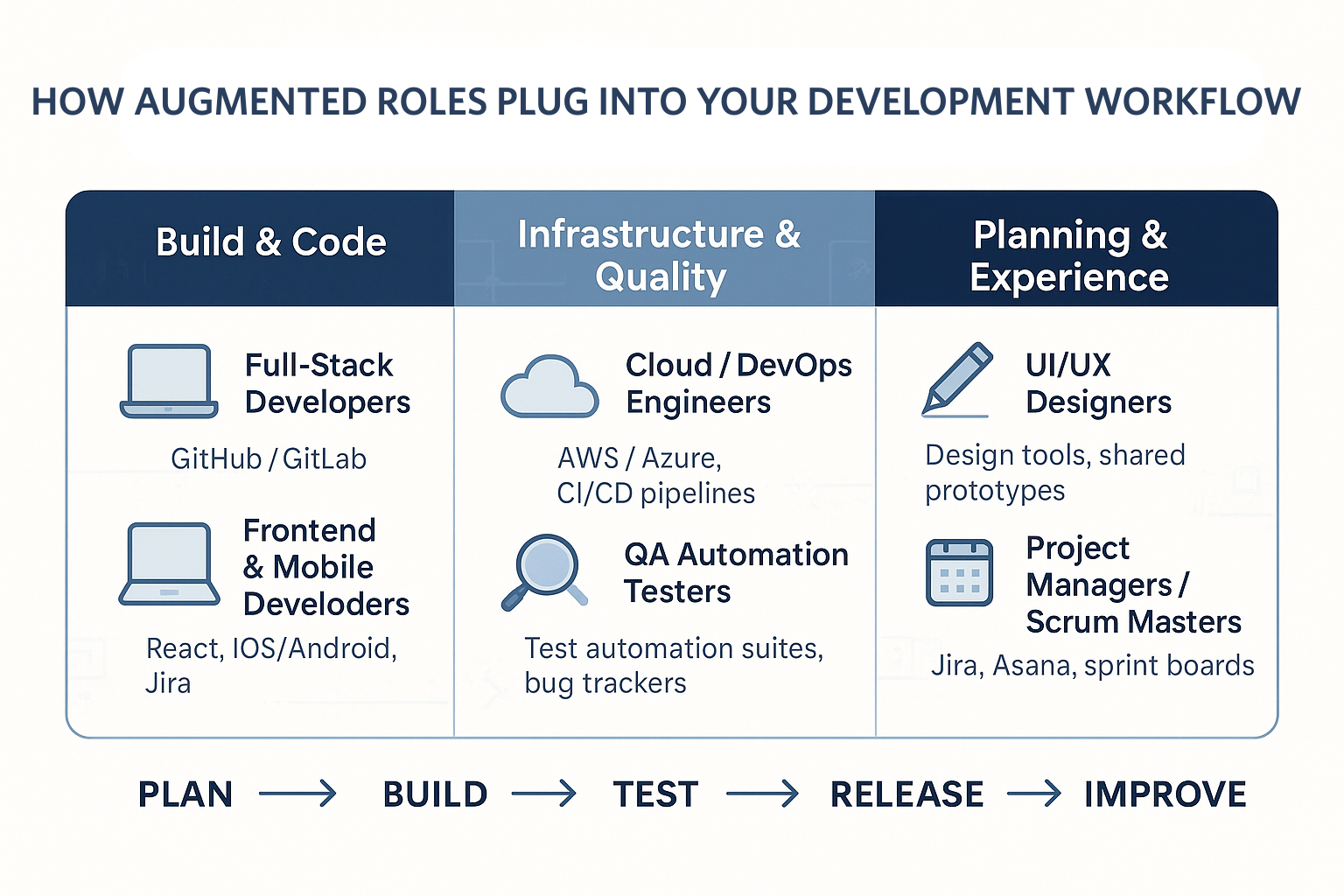
When you need to scale your team quickly, full-stack developers are among the most requested positions. These professionals handle both front-end and back-end work, making them valuable for complete project coverage. Mobile app developers are equally important if you’re building iOS or Android applications.
Infrastructure and Quality Assurance
Cloud developer augmentation has grown significantly as more companies move to cloud-based systems. Cloud engineers help you build, manage, and optimize your infrastructure on platforms like AWS, Azure, or Google Cloud. Data engineers also fall into this category, helping you process and organize large amounts of information.
Augmented QA testing teams ensure your applications work correctly before release. QA automation testers create scripts and frameworks that check for bugs and performance issues automatically.
Design and Project Management
UI/UX designers improve how your application looks and functions for users. They focus on creating interfaces that are easy to use and visually appealing.
You can also bring in project managers or Scrum masters to keep your development process organized. These roles help coordinate team efforts, track progress, and remove obstacles that slow down delivery. They’re especially useful when managing larger teams or complex projects with tight deadlines.
When Should You Use Application Development Staff Augmentation?
Staff augmentation works best for specific situations where you need extra skills or team members without long-term hiring commitments. Understanding when to use this approach and when to avoid it helps you make smart decisions about your development projects.
Project Scenarios Where Augmentation Makes Sense
Short-term projects with clear deadlines are ideal for staff augmentation. If you’re building a new mobile app that needs to launch in six months, you can bring in developers who specialize in that platform. Once the project wraps up, those developers move on without you handling layoffs or reassignments.
Seasonal workload increases also benefit from this model. Many businesses see higher demand during certain times of year. You can scale your team up when orders spike and scale back down when things slow down.
Staff augmentation works well when you need specialized technical skills for a specific project phase. Maybe your team needs a security expert to handle compliance requirements, or you need someone skilled in a particular framework. These experts join your team temporarily and fill those knowledge gaps.
Testing and quality assurance phases often require extra hands. You might need several QA engineers to test your application before launch, but you won’t need that many once the product is stable.
Signs Your Internal Team Needs Support
Your team is missing crucial technical skills for current projects. You want to build features using new technology, but nobody on your team has experience with it. Hiring permanent staff takes months, but augmentation gets you those skills in weeks.
Project deadlines are at risk because your team is stretched too thin. Your developers are working overtime and still falling behind schedule. Adding augmented staff helps you meet deadlines without burning out your core team.
You notice increased employee stress and turnover. When your team constantly juggles multiple priorities, quality suffers and people leave. Bringing in support staff lets your team focus on their main responsibilities.
Multiple projects are competing for the same resources. Your business needs to run several initiatives at once, but you only have enough developers for one or two. Staff augmentation lets you pursue multiple goals without choosing between important projects.
When Staff Augmentation Is Not the Right Choice
Core business functions should stay in-house. If you’re building the main product that defines your company, you need permanent team members who understand your vision and will grow with your business. Temporary staff won’t have the same investment in your long-term success.
Staff augmentation fails when you have no clear project scope or requirements. If you don’t know what you need built or how long it will take, you can’t effectively manage augmented staff. You need solid planning before bringing in outside help.
Your team lacks management capacity to oversee additional people. Augmented staff still need direction, code reviews, and integration with your existing team. If your managers are already overwhelmed, adding more people creates chaos instead of solutions.
This model doesn’t work when you need deep company knowledge and culture fit. Some projects require understanding your customers, business processes, and company values. New augmented staff won’t have this context and might make decisions that don’t align with your goals.
Budget constraints can make augmentation impractical. While often cheaper than full-time hires, augmentation still costs money. If you need long-term help for over a year, permanent employees usually cost less than paying augmentation rates indefinitely.
Tools Used to Support Augmented Development Teams
When you bring augmented developers onto your team, the right tools make all the difference. These platforms help everyone work together smoothly, no matter where they are located.
Communication tools keep your whole team connected in real time. Slack and Microsoft Teams are popular choices because they let you create channels for different projects and send quick messages. Zoom and Google Meet work well for video calls and screen sharing during meetings.
Your team needs sprint planning tools to stay organized and track progress. Jira helps you manage sprints, create user stories, and monitor what everyone is working on. Trello offers a simpler option with boards and cards that show tasks visually. Azure DevOps combines project tracking with other development features in one place.
Code management platforms are essential for developers to collaborate on code. GitHub and GitLab let your team share code, review changes, and manage different versions. Bitbucket integrates well with other Atlassian products and supports Git repositories.
Knowledge sharing tools help augmented staff get up to speed quickly. Confluence works great for creating documentation and project wikis that everyone can access. Notion provides flexible workspaces where you can store notes, processes, and important information. Google Workspace gives your team shared documents and spreadsheets for easy collaboration.
These tools create a strong foundation for your augmented team. They make sure communication flows smoothly and everyone stays aligned on goals and tasks.
Key Benefits of Staff Augmentation in Application Development
Staff augmentation transforms how you build applications by connecting you with skilled developers who join your team temporarily. This approach delivers immediate access to technical experts, flexible team scaling options, significant cost savings, and faster project launches.
Access to Specialized Skills and Technical Expertise
Your application projects often require specific technical skills that your current team doesn’t have. Staff augmentation gives you direct access to a global talent pool of experts in areas like artificial intelligence, cloud computing, mobile development, and emerging technologies.
You can fill skill gaps quickly without the long process of traditional recruiting. Need a React Native developer for three months? You can bring one onto your team in weeks instead of waiting months to hire someone permanently.
The global talent pool means you’re not limited to developers in your local area. You can work with specialists from around the world who have the exact experience your project needs. These professionals bring fresh perspectives and proven methods from working on similar projects.
Key specialized skills available through staff augmentation:
- Mobile app development (iOS, Android, cross platform)
- Cloud architecture and DevOps
- AI and machine learning integration
- Blockchain and Web3 technologies
- Cybersecurity and data protection
Flexibility to Scale and Rapid Team Expansion
Staff augmentation provides scalability that matches your project demands. You can add developers when workload increases and reduce team size when projects wind down.
This flexibility helps you respond to changing business needs without the commitment of permanent hires. Your development team can grow from five to fifteen people for a product launch, then return to normal size afterward.
You maintain control over your project direction and daily operations. Augmented staff members work as part of your team, following your processes and reporting structures. They integrate with your existing team members while you keep full oversight of the development work.
The speed of team expansion gives you a competitive advantage. While competitors spend months recruiting, you can scale your development team and start building in weeks.
Cost Efficiency and Savings
Traditional hiring creates expenses beyond salary. You pay for recruitment, benefits, office space, equipment, training, and other overhead costs that add up quickly.
Staff augmentation delivers cost savings by eliminating most of these expenses. You pay for development expertise without the burden of full time employee benefits, payroll taxes, or long term commitments. Most companies save between 40% and 70% on development costs compared to traditional hiring.
Cost comparison:
| Expense Type | Traditional Hiring | Staff Augmentation |
|---|---|---|
| Recruitment costs | High | None |
| Benefits packages | Required | Not required |
| Training time | 3 to 6 months | Minimal |
| Office overhead | Full cost | Reduced or none |
| Long term commitment | Years | Project based |
The cost effectiveness extends beyond direct expenses. You avoid paying salaries during slow periods and don’t need to create work to keep employees busy between projects.
Accelerated Onboarding and Time-to-Market
Augmented developers arrive ready to contribute. They bring experience from previous projects and require minimal training to start working productively.
Standard onboarding takes 2 to 6 weeks compared to 30 to 70 days with traditional hiring. This accelerated time to market means your application reaches users faster and you start generating revenue sooner.
Pre vetted professionals understand development workflows, collaboration tools, and industry best practices. They can review your requirements, understand your codebase, and begin contributing meaningful work within days.
Faster onboarding also means faster project completion. Your team maintains momentum instead of waiting for new hires to get up to speed. Critical features ship on schedule and your product stays ahead of competitors.
The combination of quick integration and immediate productivity keeps your development timeline on track. You meet launch dates, respond to market opportunities, and deliver value to users without unnecessary delays.
Implementing Effective Staff Augmentation Strategies
Success with staff augmentation services depends on choosing the right provider, smoothly adding new team members to your current staff, setting up proper tools for working together, and making sure knowledge gets shared while maintaining high standards.
Selecting the Right Staff Augmentation Provider
Finding the right team augmentation partner makes a big difference in your project outcomes. You need to look at providers who have experience in your specific technology stack and industry.
Check their track record by asking for case studies and client references. A good provider should have software developers who match your technical needs and can start contributing quickly. Look at how they vet their talent and what screening processes they use.
Consider these factors when evaluating providers:
- Technical expertise in your required programming languages and frameworks
- Communication skills and English proficiency levels
- Time zone alignment with your core business hours
- Pricing models that fit your budget and project timeline
- Contract flexibility for scaling up or down as needed
You should also assess their replacement policies. If an augmented staff member doesn’t work out, the provider should offer quick replacements without extra costs.
Integrating Augmented Staff into Existing Teams
Getting new augmented staff members working smoothly with your existing team requires planning from day one. You need to treat them as part of your core team, not as outsiders.
Start with a structured onboarding process. Give them access to your code repositories, documentation, and development environments right away. Share your coding standards, workflow processes, and project goals clearly. Schedule one on one meetings with key team members so they understand who handles what.
Set up regular check ins during the first few weeks. This helps catch any confusion early and builds relationships between your permanent staff and augmented team members. Make sure they attend your team meetings, standup calls, and planning sessions.
Create a buddy system where each augmented developer pairs with someone from your existing team. This speeds up learning and helps them feel included in your company culture.
Utilizing Collaboration and Communication Tools
The right collaboration tools keep everyone connected and development projects moving forward. You need platforms that support real time communication and progress tracking.
Slack works well for daily conversations, quick questions, and team updates. Set up specific channels for different projects or topics so discussions stay organized. GitHub handles code reviews, version control, and documentation in one place.
For project management, tools like Jira, Asana, or Notion help track tasks and deadlines:
| Tool | Best For | Key Features |
|---|---|---|
| Jira | Complex development workflows | Sprint planning, bug tracking, agile boards |
| Asana | Task management and timelines | Project views, dependencies, progress reports |
| Notion | Documentation and wikis | Collaborative docs, databases, knowledge bases |
Set clear communication protocols from the start. Define when to use synchronous vs asynchronous communication. Establish response time expectations and meeting schedules that work across time zones.
Ensuring Knowledge Transfer and Quality Control
Knowledge transfer protects your business when augmented staff members finish their contracts. You need systems that capture important information and maintain code quality throughout the project.
Document everything as work happens. Require code comments, readme files, and architecture decisions to be written down in tools like Notion or GitHub wikis. Have augmented developers record video walkthroughs of complex features they build.
Set up quality control measures using KPIs that matter for your project. Track metrics like code review completion rates, bug counts, test coverage, and feature delivery timelines. Regular code reviews ensure standards stay consistent across your whole team.
Create handoff procedures before contracts end. Schedule knowledge transfer sessions where augmented staff explain their work to permanent team members. Make sure all credentials, access rights, and project materials get properly transferred or revoked.
Conduct exit interviews to learn what worked well and what could improve. This feedback helps you refine your staff augmentation approach for future needs.
Challenges and Considerations for Application Development Staff Augmentation
Adding external developers to your team can speed up projects and bring in specialized skills, but it also creates specific challenges you need to address. Communication barriers, security concerns, and coordination across different locations require careful planning to ensure your augmented staff integrates smoothly with your existing team.
Addressing Communication Gaps and Remote Collaboration
Communication gaps are one of the biggest obstacles when you bring augmented staff into your development projects. Your augmented developers might not have immediate access to the context and information that your internal team takes for granted. This can slow down decision making and create misunderstandings about project requirements.
You need to establish clear communication channels from day one. Set up regular video meetings where team members can discuss progress and blockers in real time. Use collaboration tools like Slack or Microsoft Teams to keep everyone connected throughout the workday.
Document your processes, coding standards, and project requirements in a central location where all team members can access them. This helps augmented staff find answers quickly without waiting for responses. Create a knowledge base that includes technical specifications, user experience guidelines, and project workflows.
Remote collaboration requires more structure than working with people in the same office. Schedule daily standups to keep everyone aligned on priorities. Use project management tools to track tasks and deadlines so nothing falls through the cracks.
Data Protection and Confidentiality Agreements
Your application likely handles sensitive data that needs protection from unauthorized access or leaks. When you add augmented staff to your team, you expand the number of people who can access your systems and proprietary information.
You must require confidentiality agreements from all augmented staff before they start work. These legal documents should clearly define what information is confidential and what happens if someone violates the agreement. Include specifics about intellectual property ownership and restrictions on sharing code or project details.
Data protection measures need to extend to your augmented team members. Provide secure access to your systems through VPNs and multi factor authentication. Limit access rights so augmented staff can only see the data and systems they need for their specific tasks.
Review the security practices of your staff augmentation provider before signing a contract. Ask about their data handling procedures, employee vetting processes, and compliance with regulations like GDPR or CCPA. Your digital transformation efforts depend on maintaining trust with your users, which means protecting their information at every level.
Managing Cultural Differences and Time Zones
Working with augmented staff often means collaborating with people from different countries and cultural backgrounds. These differences can affect how people communicate, make decisions, and approach problem solving.
Time zones create scheduling challenges that you need to plan around. If your augmented developers are eight hours ahead or behind your main team, you might have limited overlap for real time collaboration. Find a few hours each week when everyone can meet at a reasonable time. Record important meetings so team members in different zones can catch up later.
Cultural differences show up in communication styles. Some cultures prefer direct feedback while others communicate more indirectly. Team members might have different expectations about work hours, response times, and meeting formality. Take time to learn about these differences and create team guidelines that respect various working styles.
Build in extra time for clarification and questions when working across cultures. What seems obvious to you might need explanation for someone from a different background. This patience improves your user experience development because diverse perspectives help you create applications that work for a wider audience.
Frequently Asked Questions About Application Development Staff Augmentation
Is staff augmentation good for software development?
Staff augmentation works well for software development when you need specific skills quickly. It lets you add experienced developers to your team without the long hiring process. You keep control over your project while getting the expertise you need.
How much does staff augmentation cost?
The cost depends on the skills you need and where the developers are located. You typically pay an hourly or monthly rate per developer. This approach often costs less than hiring full time employees because you avoid benefits, office space, and equipment expenses.
How is staff augmentation different from outsourcing?
With staff augmentation, developers join your team and work under your direction. You manage the day to day tasks and keep control of the project. Outsourcing means you hand off an entire project to another company. They manage everything and deliver the finished product.
How do you manage augmented developers?
You manage augmented developers just like your regular team members. They attend your meetings, use your tools, and follow your processes. Clear communication is important. Set expectations early and check in regularly to make sure everyone stays aligned.
Is staff augmentation good for Agile teams?
Staff augmentation fits well with Agile development. Augmented developers can join your sprints and adapt to your workflow. They participate in stand ups, retrospectives, and planning sessions. This flexibility helps you scale your team up or down based on sprint needs.


