Your company’s data warehouse might be holding you back more than you realize. Outdated systems create bottlenecks that slow down reports, drain budgets on maintenance, and make it tough for teams to get the insights they need to make smart decisions.
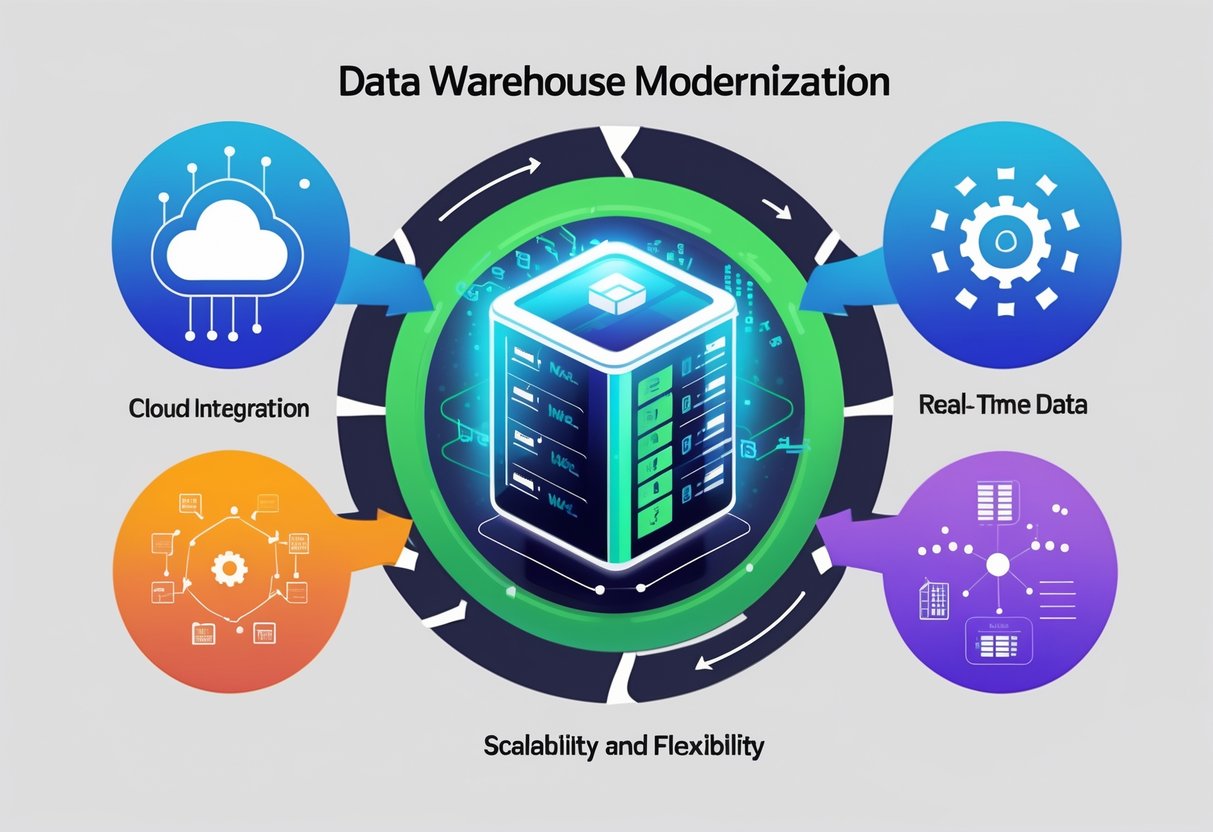
Data warehouse modernization involves updating traditional on-premise systems to cloud-based platforms that offer better speed, lower costs, and real-time analytics capabilities. This shift helps businesses escape expensive legacy setups and move toward flexible solutions that actually grow with their needs.
Getting a grip on the core concepts, benefits, and latest tech will help you make better calls about upgrading your data infrastructure. You’ll also want to understand governance challenges and keep an eye on future data trends that might shake up your business strategy.
Fundamentals of Data Warehouse Modernization
Data warehouse modernization involves upgrading your existing data storage and analytics infrastructure to handle today’s business demands. Legacy systems just can’t keep up with modern data volumes, while businesses need faster insights and more flexible cloud solutions.
Defining Data Warehouse Modernization
Data warehouse modernization means updating your old data systems to work better with today’s technology. It’s not just about moving data to new servers.
You have to rethink how your organization stores, processes, and uses data. Modern warehouses can handle way more information and do it faster than your old setup.
Modernization means refactoring the data warehouse infrastructure so that analytic workloads scale whenever needed. Adding new data sources should be almost instant, not a drawn-out project.
Key components of modernization include:
- Moving from on-site servers to cloud platforms
- Updating outdated software and databases
- Changing how data flows through your system
- Training staff on new tools and processes
The aim is to build a modern data warehouse that grows with your business. You want faster answers to business questions, not more headaches.
Why Modernization Is a Business Imperative
Your business faces more pressure than ever to make decisions based on real-time data. Legacy data warehouses just can’t keep up.
Companies that modernize their data systems pull ahead. They respond to market changes faster than competitors still stuck with clunky systems.
Business benefits of modernization:
- Faster data processing and reporting
- Lower costs for data storage and maintenance
- Better ability to handle large amounts of data
- Improved security and data protection
Digital transformation needs modern data systems. Customers want quick responses and personalized experiences—old systems just can’t deliver.
Modern data warehouse architecture enables scalable analytics and real-time decision-making. That’s a big competitive edge in today’s fast-moving markets.
Cloud data warehouses also lighten the load for your IT team. They can focus on solving business problems instead of constantly fixing old equipment.
Legacy Data Warehouse Limitations
Legacy data warehouses create real headaches for modern businesses. These systems were built for simpler times and simpler data.
Major limitations include:
| Problem | Impact on Business |
|---|---|
| Slow processing | Reports take hours or days |
| Limited storage | Cannot handle big data volumes |
| High maintenance costs | Expensive servers and software |
| Poor flexibility | Hard to add new data sources |
Your legacy system probably struggles with different types of data. Old data warehouses work fine with structured data like spreadsheets, but modern data types? Not so much.
Social media posts, website clicks, and sensor data can overwhelm legacy systems. They just weren’t built for this variety of information.
Scaling up legacy warehouses is costly. You end up buying expensive hardware and hiring specialists just to keep the lights on.
Legacy systems also have poor query performance that frustrates users. Business teams wait too long for basic reports and analysis.
Security is another big concern. Old data warehouses often lack modern protection against cyber threats and data breaches.
Key Drivers and Benefits
Modern data warehouses can bring serious improvements in scalability, cost management, agility, and analytics. These advances help organizations handle growing data volumes and empower users across the business—while actually saving money.
Scalability and Elasticity
Traditional data warehouses just can’t keep up when your data grows fast. They have fixed storage and computing power, and upgrades are pricey.
Modern data warehouses fix this with elastic scaling. You can add storage or computing power instantly, no downtime needed.
Cloud-based systems let you ramp up during busy times and scale back when things are slow. You only pay for what you use. This flexibility means you don’t have to buy hardware that sits idle most of the year.
The ability to improve scalability and agility means your system grows with your business. You won’t run out of space or power when analyzing big datasets.
Cost Efficiency and Operational Savings
Moving to a modern data warehouse slashes IT costs in a few ways. No more pricey hardware purchases or sky-high maintenance fees.
Cloud solutions charge you for what you use, not for peak capacity. This pay-as-you-go model can cut costs by 30-50% compared to old-school systems.
You also save on staff time. Modern systems need less manual work, and automated backups and updates free up your IT team for more important stuff.
Data warehouse modernization benefits include lower operational costs and better efficiency. Plus, fewer physical servers means lower electricity and cooling bills.
Agility and Data Democratization
Modern data warehouses make it easier for non-technical users to get their hands on data and analyze it. Self-service BI tools let business users create reports without waiting for IT.
Data democratization means more people in your company can make data-driven decisions. Marketing can analyze campaigns; sales can track performance; HR can review hiring data. Everyone gets in on the action.
Data catalogs make it easier to find what you need. These tools show what data exists and how to use it. Less time hunting for the right dataset means more time actually putting data to work.
Better data quality tools catch errors before they mess up your analysis. Automated validation keeps your data accurate and reliable across departments.
Accelerated Analytics and Business Intelligence
Modern data warehouses process queries much faster than the old systems. What used to take hours now happens in minutes—or even seconds.
Real-time analytics let you see how your business is doing right now, not last week. You can spot problems early and jump on opportunities before they slip away.
Advanced BI platforms pair well with modern warehouses. They support complex visualizations and interactive dashboards that actually make sense of your data.
Machine learning tools plug right into modern systems. That means you can build predictive models and spot patterns in your data that you’d never see otherwise. Enhanced performance and real-time analytics capabilities give you a real edge through faster insights.
Modern Architectures and Technologies
These days, data warehouse modernization is all about cloud platforms that offer scalable, flexible solutions. New patterns like data lakes and hubs help you integrate data from all over, while supporting real-time analytics and machine learning workloads.
Cloud Platforms and Cloud-Native Solutions
Cloud platforms have changed the game for data warehousing. Big names like AWS, Microsoft Azure, and Google Cloud offer fully managed warehouse services that scale automatically based on your needs.
Cloud data warehouses mean no more physical hardware headaches. You can spin up resources in minutes. These platforms handle updates, security patches, and performance tweaks for you.
Key benefits of cloud-native platforms include:
- Pay-per-use pricing
- Automatic scaling during peak loads
- Built-in disaster recovery
- Global data distribution
Multi-cloud strategies help you avoid getting locked into one vendor. You can use different clouds for different workloads or regions, but you’ll need to plan carefully for data movement and integration.
Cloud computing also makes microservices architectures possible. These break big data tasks into smaller, independent services that can scale on their own.
Data Lakes, Hubs, and Ecosystems
Data lakes store raw data in its original format until you need it. Unlike traditional warehouses, they handle structured, semi-structured, and unstructured data all in one place.
You can set up a data lake alongside your warehouse, creating a full data ecosystem for different analytics needs. Modern data architectures like data hubs and fabrics give you unified access across multiple storage systems.
Data hubs act as central connection points, managing data flows between systems and apps. This cuts down on messy point-to-point connections and simplifies your infrastructure.
Your data ecosystem might include:
- Operational databases
- Data warehouses
- Data lakes
- Real-time streaming platforms
- Analytics tools
Each piece has its own job, but they work together. APIs connect these systems and let data flow between applications.
Data Modeling and Integration Approaches
Modern data integration handles all kinds of sources way better than the old methods. You can connect to databases, cloud services, IoT devices, and web APIs through unified platforms.
Extract, Transform, Load (ETL) has evolved. ELT (Extract, Load, Transform) stores raw data first and transforms it later, which works well with cheap cloud storage and strong processing power.
Real-time integration supports instant analytics. Stream processing platforms handle continuous flows from apps, sensors, and user actions.
Data modeling approaches include:
- Star schema – Simple, fast queries
- Snowflake schema – Normalized, space-efficient
- Data vault – Flexible, audit-friendly
- Dimensional modeling – Business-focused structure
You can also use data virtualization to access info without moving it. This creates logical views across systems while keeping data in place. APIs and microservices make this distributed approach work by providing standard access methods.
Governance, Management, and Future Trends
Modern data warehouse governance is all about striking the right balance—meeting compliance needs while staying agile. Advanced analytics like machine learning and predictive modeling are changing how organizations think about data products and new development strategies. The future’s coming fast, and it’s going to be interesting to see who keeps up.
Data Governance and Compliance
Modern data governance planning works best when you start small and iterate—no need for a big-bang rollout. You’ll want clear policies that spell out who owns data, who can access it, and what quality standards apply across your warehouse.
Data stewardship matters a lot when you’re juggling multiple data sources. Your team should define roles for data owners, custodians, and users so there’s real accountability (not just in theory).
Compliance frameworks differ by industry, but you’ll commonly need:
- Data lineage tracking for audit trails
- Access logging and monitoring
- Data retention policies that fit regulations
- Privacy controls for sensitive info
Automated governance tools are a must if you want to keep up with growing data volumes. Manual processes just can’t keep pace once your warehouse starts to scale up.
Managing Data Complexity and Silos
Data silos crop up when departments spin up their own systems that don’t talk to each other. It’s a headache when you try to bring together different data sources and ERP systems.
Breaking down silos isn’t just a tech fix—it’s organizational too. Aim for unified data models that actually serve more than one team.
Typical complexity headaches include:
- Schema variations between sources
- Data format inconsistencies across apps
- Timing differences in updates
- Conflicting business rules from different groups
Zero-code ETL tools can make a real difference, letting business users build data pipelines without needing to code. That lowers the barrier to entry quite a bit.
It’s worth setting up data cataloging practices—document what data you have, what it means, and how it connects. That way, teams waste less time hunting for info or duplicating work.
Machine Learning, Predictive Analytics, and Advanced BI
Machine learning turns your warehouse from a reporting engine into a predictive platform. You can build models right inside platforms like BigQuery or Redshift using their built-in ML features.
Predictive analytics needs clean, well-organized data that refreshes regularly. Your warehouse should handle both batch and real-time feeds, depending on what the models need.
Some common ML use cases:
- Customer behavior prediction for marketing
- Demand forecasting for supply chain
- Fraud detection for financial ops
- Maintenance scheduling for equipment
Don’t forget about model governance—it’s just as important as data governance. You’ll need version control, performance tracking, and ways to catch bias in your ML workflows.
Data products show up when you bundle analytics for specific business needs. These self-serve tools let business users get insights on their own, without always leaning on IT.
Continuous Modernization and Greenfield Strategies
Continuous modernization means you update your warehouse bit by bit instead of ripping everything out at once. You can move workloads in phases and keep business running smoothly.
Greenfield development is your chance to build new systems without old baggage. CIOs sometimes go this route if their current setup just can’t handle what’s next.
Your modernization plan might include:
- Hybrid cloud deployments
- API-first integrations
- Microservices for better scaling
- DevOps practices for faster releases
Data management keeps evolving—generative AI and advanced analytics are already changing the game. It’s smart to plan for tech that isn’t here yet but will matter in the next few years.
Future-proofing is about picking platforms and tools that can flex as your needs change. Make sure your architecture can handle new data types and processing methods as they show up.
Frequently Asked Questions
Data warehouse modernization leads to faster insights and cost savings you can actually measure. Teams usually notice better performance thanks to cloud adoption, real-time processing, and AI-powered analytics that really change how data gets used.
What are the primary benefits of modernizing a data warehouse infrastructure?
Modern warehouses offer twice the speed and about 50% cost savings over legacy systems. You get faster queries and better processing speeds.
Your org can scale more easily as business grows. Cloud solutions remove the hardware limits that used to hold you back.
You’ll see better integration across sources and formats—finally, a single source of truth for your decisions.
Modern setups support real-time analytics, not just old-school batch jobs. Teams act on fresh data, not yesterday’s news.
How does cloud computing impact data warehouse modernization?
Cloud platforms give you unlimited storage and compute power when you need it. You pay for what you use, not for racks of idle servers.
Your warehouse scales up or down automatically during busy times—no more guessing at future needs.
Cloud providers handle a lot of the security and compliance heavy lifting. That’s less for your team to worry about.
Multi-region deployments mean faster data access worldwide. Your teams in different countries get better performance, no matter where they are.
What are the key strategies for integrating real-time data processing into an existing data warehouse?
Set up streaming pipelines to capture data as it happens. That way, you move away from old batch loads to a steady flow.
Change data capture tools let you process only what’s new or updated, which saves time and resources.
Consider adding a separate real-time layer next to your existing warehouse. You can keep things running while rolling out new features.
Put automated data quality checks right into your streaming processes. Real-time data should be just as accurate as batch data—no shortcuts.
How do advanced analytics and AI capabilities play a role in the evolution of data warehouses?
AI-powered query optimization keeps making your database faster over time. The system learns which requests are common and speeds them up.
Machine learning catches data quality issues and weird anomalies automatically, so you catch problems before they hit your reports.
Predictive analytics uses past data to forecast trends. Your teams can finally make proactive, not just reactive, choices.
Natural language processing lets business users ask questions in plain English—less need to bug IT for simple reports.
What best practices should organizations follow when transitioning from legacy systems to modern data warehousing solutions?
Start with a pilot using non-critical data. That way, you can test your modernization approach before moving the important stuff.
Modernization means understanding the differences between old and new architectures. Strategic decisions about storage really matter here.
Keep old and new systems running in parallel for a while. That keeps business humming while you migrate behind the scenes.
Train your team on new tools before the big switch. It’s the best way to avoid slowdowns from unfamiliar tech.
Document all your data mappings and transformation rules as you go. You’ll thank yourself later when it’s time for maintenance or troubleshooting.
How can a business ensure data governance and compliance during the process of data warehouse modernization?
Start by figuring out who owns what data and set up access controls before kicking off migration. That way, you’re not scrambling to maintain security standards while everything’s in motion.
It’s smart to use automated compliance monitoring that can actually track data lineage and usage. This sort of system helps keep tabs on how information moves through your processes, and, honestly, it saves headaches later.
Don’t forget audit trails—they log every data change and access attempt. That’s not just for show; it’s how you keep up with regulatory requirements and can actually prove what happened if anyone asks.
Set up data classification schemes to spot sensitive info automatically. It’s easier to apply the right security when you know exactly what you’re dealing with and how risky it is.
And, yeah, regularly test your backup and recovery procedures during modernization. If something goes sideways during migration, you’ll want to be sure you can keep the business running without missing a beat.
Data Warehousing Modernization Services from Atiba
Modernizing your data warehouse isn’t just an IT upgrade—it’s a business evolution. When your data systems run smoothly, decisions get sharper, innovation speeds up, and your teams spend less time waiting on reports and more time acting on insights. The shift to modern, cloud-based architectures gives your business the flexibility to grow without the limits of outdated infrastructure.
But the process can be complex, especially when you’re balancing governance, security, and real-time performance. That’s where having the right partner makes all the difference.
Atiba helps companies modernize their data environments from the ground up, combining deep technical expertise with a business-first approach. Whether you’re migrating from legacy systems, integrating AI and analytics, or building a cloud-native architecture from scratch, we help you create a data foundation that’s fast, scalable, and future-ready.
If you’re ready to turn your data into a true competitive advantage, let’s talk about how Atiba can help modernize your data warehouse and move your business forward with confidence.