You’ve got a data warehouse – maybe it’s been with you through thick and thin, or maybe it’s just starting to feel a bit… cramped. Whatever the reason, the thought of “data warehouse migration” can sound like a headache wrapped in a nightmare. But fear not! This isn’t just about moving files; it’s about upgrading your data’s digs for a future-proof, high-performance pad. It’s a bit like finally deciding to renovate that old Victorian house – the possibilities are exciting, but the prospect of uncovering hidden plumbing issues can be daunting.
From Punch Cards to the Cloud: A Whirlwind Tour of Data’s History
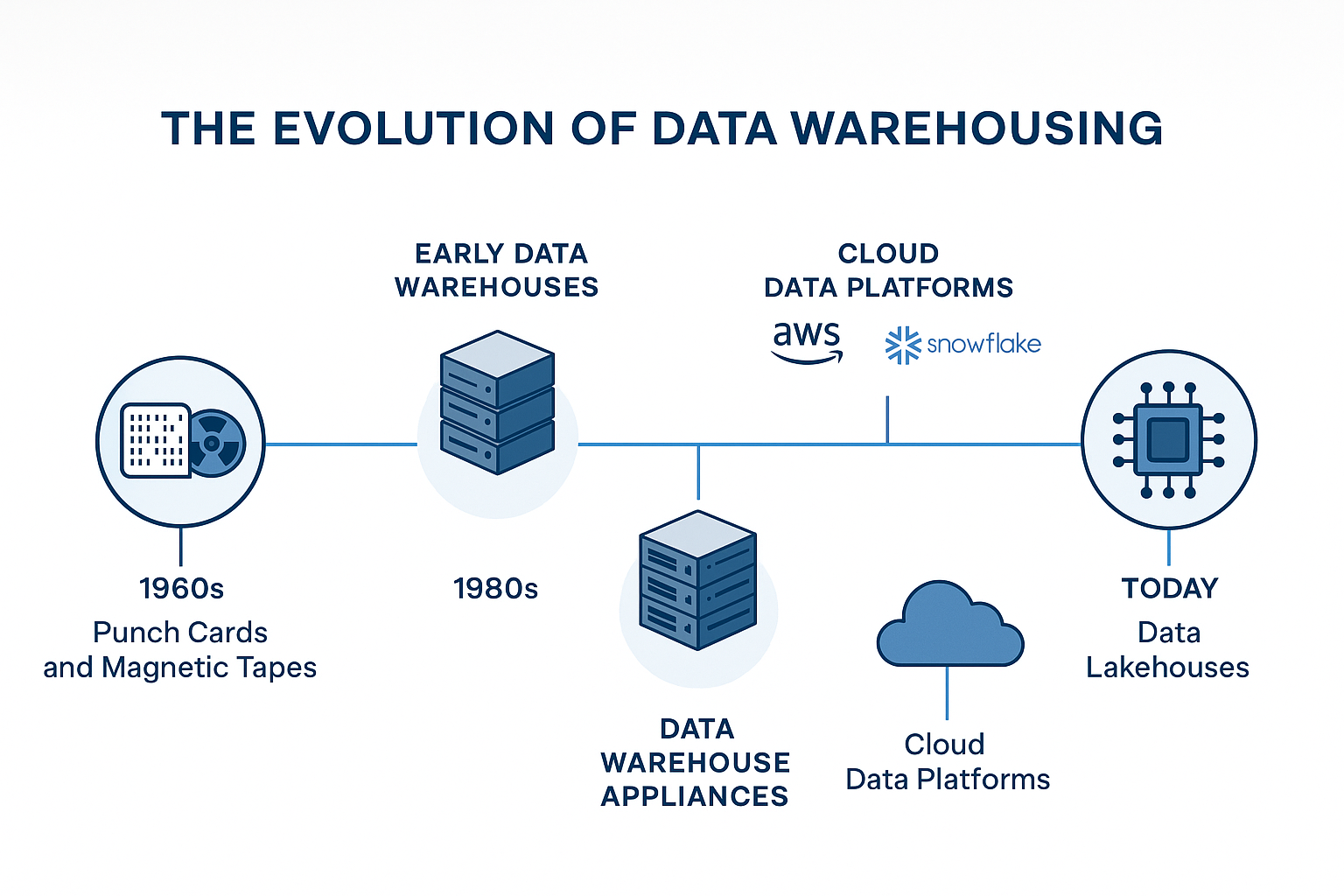
Remember the good old days? (If you don’t, your company’s legacy systems probably do.) Data storage started small, with clunky punch cards and then magnetic tapes – the digital equivalent of hieroglyphics, perhaps? Then came the ’80s and the “father of data warehousing,” Bill Inmon, who envisioned these grand, centralized data hubs. Back then, migrating meant hauling hardware and tweaking complex “Extract, Transform, Load” (ETL) processes. A physical, almost Sisyphean task.
Fast forward to the 2000s: we got specialized data warehouse “appliances” that were faster but still tied to physical boxes. The data center became less a library and more a server farm. Then, the game truly changed with the cloud. What started as a risky experiment in the late 2000s (hello, early AWS Redshift!) is now the superstar, promising scalability, cost savings, and access to all the fancy AI/ML toys. We’ve gone from moving literal boxes to clicking buttons (mostly). It’s a true paradigm shift – a move from owning the means of production to renting access to near-infinite capacity.
The Big Move: What’s the Game Plan?
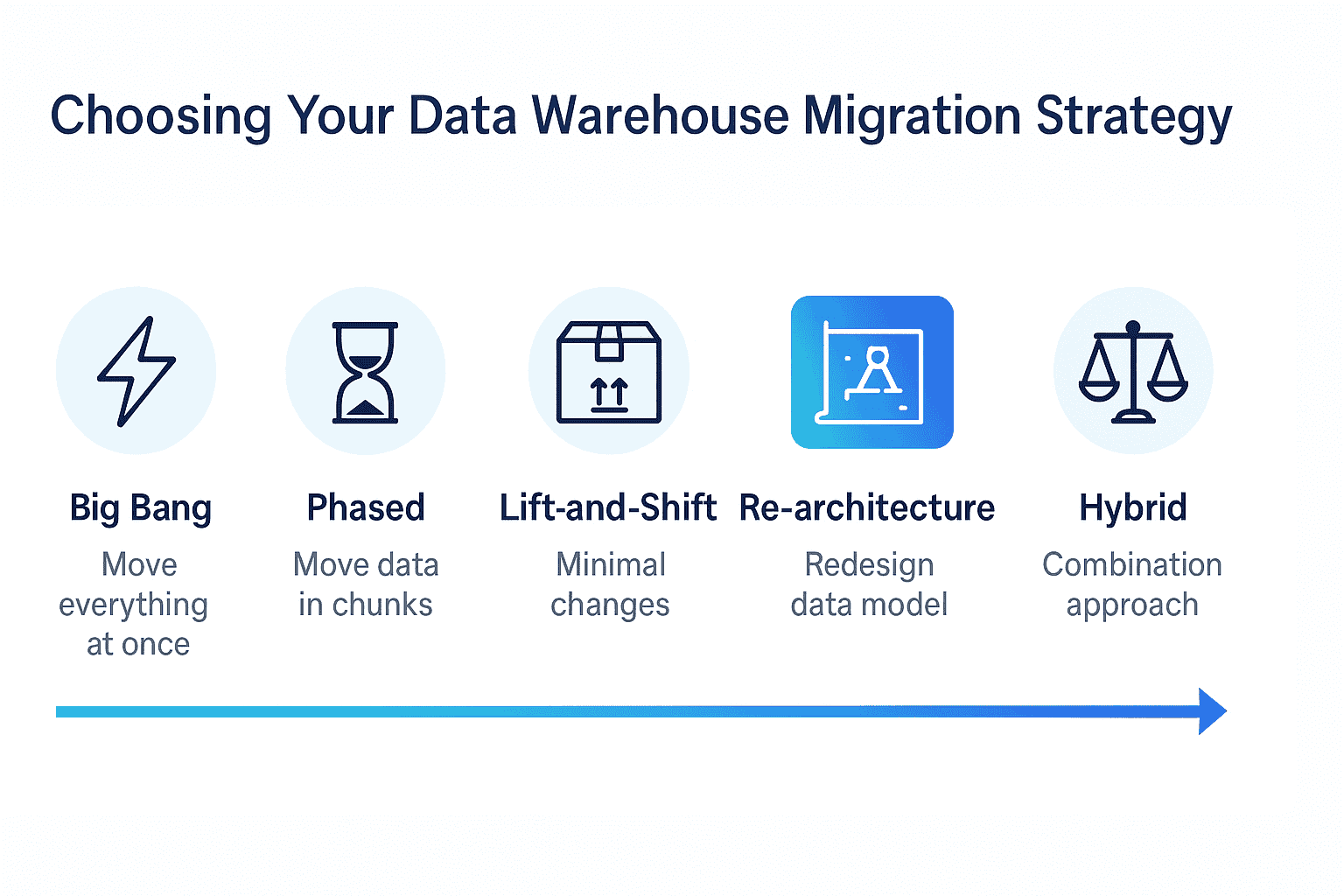
So, you’re ready to pack your data’s bags. But how do you actually get it from A to B? Turns out, there’s more than one way to migrate a data warehouse, each with its own quirks and considerations:
- The “Big Bang” (Rip the Band-Aid Off): Move everything at once. Quick, potentially cheaper upfront, but high-risk if things go sideways. Think of it as moving all your furniture in one go – exhilarating, but one wrong turn and you’re in trouble. It’s akin to shock therapy – effective if it works, disastrous if it doesn’t.
- The “Phased Approach” (Slow and Steady Wins the Race): Move data in chunks, domain by domain. Less risky, easier to fix issues along the way, but it takes longer. Like moving room by room, ensuring each one is perfect before tackling the next. This mirrors the incremental approach favored in scientific inquiry – methodical and deliberate.
- “Lift-and-Shift” (Pack It As-Is): Take your current data warehouse and plop it into the new environment with minimal changes. Fast, less disruptive initially, but you might not be fully optimized for the new digs. It’s like moving your old couch to a new, modern apartment – it fits, but does it really belong? Functionally equivalent, perhaps, but aesthetically… suspect.
- “Re-architecture” (Full Renovation!): Redesign your data model and architecture to fully embrace the new environment, especially for cloud-native platforms. More complex, more time, but unlocks better performance and new capabilities. This is gutting the old place and building your dream home. A bold move, signifying a complete re-evaluation of first principles.
- “Hybrid” (Best of Both Worlds?): A mix of the above. Maybe lift-and-shift initially, then re-architect later. Or keep some sensitive data on-premises while leveraging the cloud for everything else. The pragmatic approach, acknowledging that reality is rarely black and white.
Where are we moving? Most businesses are ditching dusty server rooms for the cloud (on-premises to cloud). But there’s also a growing trend of cloud-to-cloud moves (from one cloud provider to another) and even modernizing on-premises to on-premises if the cloud isn’t your jam. The data gravity is undeniably pulling towards the cloud, yet some orbits remain tethered to the earth.
Not So Fast! The Bumps in the Road (and How to Avoid Them)
Sounds exciting, right? But data warehouse migrations aren’t always a smooth ride. They come with their fair share of headaches:
- Data Integrity Nightmares: The biggest fear! Losing, corrupting, or duplicating data. Imagine moving all your possessions only to find half your wardrobe went missing and your priceless vase is now a jigsaw puzzle. This needs meticulous planning and constant validation. Data, like memories, can be fragile and easily distorted.
- The Downtime Dilemma: Every minute your data warehouse is down, your business might be losing money or missing critical insights. Planning for minimal disruption is key. In the age of instant gratification, even momentary interruptions can feel like an eternity.
- Cost Creep: Cloud promises savings, but migrations themselves can be pricey. Underestimating the effort, tools, or unforeseen issues can lead to budget blowouts. The allure of scalability can be seductive, but it’s crucial to maintain fiscal discipline.
- The Skills Gap: Does your team know the ins and outs of both your old system and the shiny new one? Lack of expertise can cause delays and errors. A mastery of both the classical and the modern is essential for navigating this transition.
- Technical Headaches: Old systems often speak a different language than new ones. Getting them to play nicely (schema mapping, data transformations) is a huge challenge. Like trying to translate ancient Sumerian into Python – context is everything.
- Security & Compliance Scares: Moving sensitive data means new security protocols and ensuring you’re still adhering to regulations like GDPR or HIPAA. The ethical considerations are paramount – data privacy is not a luxury, but a right.
The “Inmon vs. Kimball” Debate (The OG Controversy): Back in the day, data warehousing gurus Bill Inmon and Ralph Kimball had differing philosophies on how to design these systems. Inmon advocated a top-down, enterprise-wide approach, while Kimball preferred a bottom-up, departmental focus. While less of a direct migration controversy today, choosing a migration strategy often implicitly leans towards one philosophy or the other, impacting how you structure your new data home. This echoes the age-old debate between grand, centralized planning and decentralized, emergent order.
The Future’s So Bright, Your Data Needs Shades
The world of data is constantly evolving, and so are migration strategies. Here’s what’s on the horizon:
- AI and Machine Learning to the Rescue: Expect AI to take over more of the heavy lifting. Think automated data quality checks, predictive analytics for potential migration issues, and even AI-driven code conversion from old systems to new cloud platforms. It’s like having a super-smart moving crew that anticipates problems before they happen. A future where algorithms assist us in our most complex endeavors.
- The Rise of the “Data Lakehouse”: The lines between flexible “data lakes” (for all kinds of raw data) and structured “data warehouses” are blurring. Data lakehouses offer the best of both worlds, providing a unified platform for diverse data types and advanced analytics. Migrating to one of these unified platforms is a hot trend. A synthesis of structure and flexibility, offering the best of both worlds.
- Real-time Everything: Businesses want insights now. Future data warehouses and migration strategies will focus on seamless real-time data streaming and processing, especially with the explosion of IoT devices. The relentless pursuit of immediacy, blurring the lines between observation and action.
- Zero-Copy Data Sharing & Zero ETL: Imagine moving data without actually moving it. New technologies are aiming to minimize or even eliminate the need for traditional ETL processes and data replication, making data access faster and more efficient. A technological singularity where data flows effortlessly.
- Code-First & Automation: Data teams are embracing software engineering best practices, moving towards code-based, version-controlled workflows for data transformations. Automation tools will become even more sophisticated, reducing manual effort and human error. The professionalization of data management, bringing rigor and repeatability to the process.
- More Cloud-to-Cloud Jumps: As organizations become more comfortable with cloud, expect them to switch between providers or migrate to different cloud-native formats (like a lakehouse) for better features or pricing. The emergence of a multi-cloud landscape, where organizations strategically leverage different platforms for different needs.
Ready for Your Data’s New Adventure?
Data warehouse migration isn’t just a technical chore; it’s a strategic opportunity to empower your business with faster, more insightful data. By understanding the historical journey, weighing your migration options, being aware of the pitfalls, and keeping an eye on future innovations, you can ensure your data’s big move is a success story, not a horror show. So, start planning that housewarming party for your shiny new data warehouse! After all, even data deserves a celebration.